Eidesk: Understanding Its Digital Presence, Purpose, and Potential Value
Introduction
The digital world is filled with platforms, websites, software projects, and technology brands that can be difficult to understand from a simple name alone. Eidesk is one such name. It has appeared in different online and technology-related contexts, including references to web development, digital publishing, programming, applications, and software projects.
For people discovering Eidesk for the first time, the biggest challenge is separating its historical digital footprint from its current identity. Older references can provide useful clues about how a digital name developed, but they do not necessarily describe the products, services, ownership, or features that may exist today.
This distinction is particularly important when researching online platforms. Websites can change domains, businesses can change direction, products can be discontinued, and previously published information can remain searchable long after it becomes outdated.
Therefore, Eidesk is best understood as a digital identity with a history connected to technology and online projects, while its present-day value should be judged by current, verifiable information.
What Is Eidesk?
Eidesk is a name that has been associated with several areas of digital technology and online activity.
Historical references connected with the name have included subjects such as:
- Website development
- PHP-based projects
- Android applications
- Website-to-app conversion
- Programming assistance
- Online publishing
- Content management
- Digital projects and web solutions
These associations suggest that Eidesk has had a connection with the broader web-development and software ecosystem.
However, it is important not to assume that every historical service or project associated with the name remains active today. The digital industry changes rapidly, and a platform’s historical identity can be very different from its current form.
For this reason, anyone researching Eidesk should treat historical information as background rather than proof of current functionality.
The Digital Background of Eidesk
The history surrounding Eidesk appears to extend across several areas of technology and webmaster activity.
Older references have connected the name with web development and programming-related work. These areas are particularly relevant because they represent some of the fundamental technologies used to build and maintain modern websites.
Web Development
Web development involves creating, maintaining, and improving websites and web-based applications.
A web-development project may involve:
- Front-end design
- Back-end programming
- Database management
- Website administration
- Content management
- Performance optimization
- Mobile compatibility
- Security
Historical references to Eidesk have included website-development-related activity, making web technology an important part of understanding its digital background.
PHP Projects
PHP has historically been one of the most widely used server-side programming languages for websites and web applications.
It has been used to build:
- Content management systems
- Business websites
- Forums
- Publishing platforms
- E-commerce systems
- Custom web applications
References connecting Eidesk with PHP projects therefore place the name within a traditional web-development environment.
Android Applications
The Eidesk name has also appeared in connection with Android-related projects.
Mobile applications have become an essential part of the digital ecosystem because smartphones are now central to communication, entertainment, business, shopping, banking, and productivity.
Android development can involve user-interface design, application programming, database integration, APIs, authentication, notifications, and mobile optimization.
Again, these historical associations should not automatically be interpreted as evidence that Eidesk currently provides Android-development services.
Eidesk and Digital Publishing
Another interesting part of Eidesk’s historical footprint is its association with online publishing.
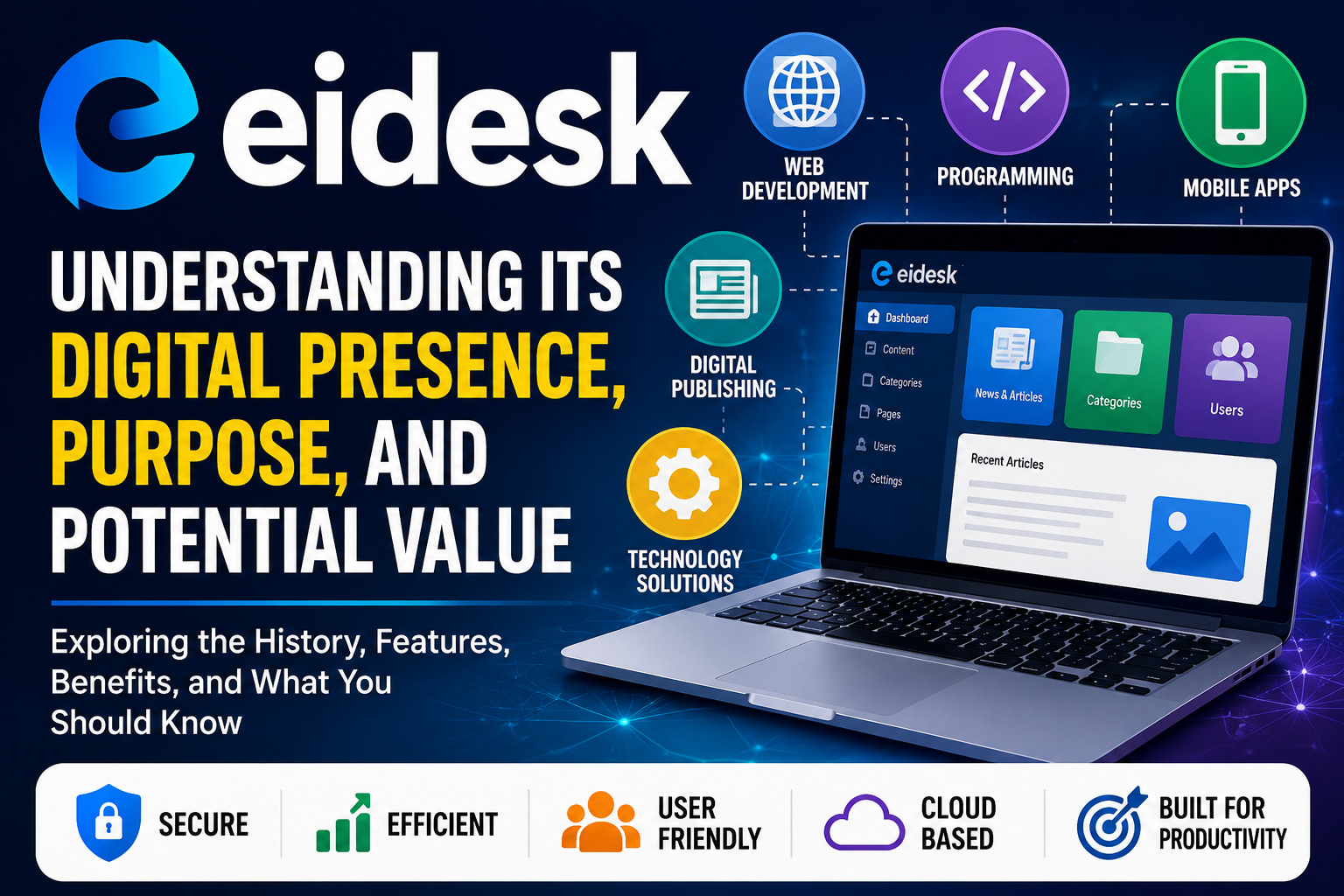
Historical material has indicated a news-oriented website concept involving features for:
- Creating categories
- Publishing articles
- Importing news
- Creating pages
- Managing users
- Organizing website content
- Managing different website elements
These features resemble the basic requirements of a content-management or digital publishing system.
A publishing platform can be particularly useful for organizations that need to manage large amounts of content without manually editing every page.
Why Content Management Matters
Modern websites often contain hundreds or thousands of pages.
A content-management system can simplify tasks such as:
- Writing an article.
- Assigning it to a category.
- Adding images or media.
- Publishing the content.
- Updating existing pages.
- Managing authors and users.
- Organizing the website structure.
This type of workflow reduces the technical barrier between content creation and website management.
The historical publishing-related references associated with Eidesk therefore provide an interesting indication of its place within the broader web-technology ecosystem.
Why Eidesk Attracts Online Interest
One reason a platform like Eidesk can attract attention is the growing demand for practical digital solutions.
Today, almost every organization depends on some form of technology.
Businesses use digital tools to manage customers, employees, documents, payments, communication, marketing, and operations. Freelancers use software to organize projects and clients. Publishers use content-management systems to create and distribute information. Developers rely on programming tools and cloud infrastructure to build digital products.
This creates strong demand for platforms that can simplify technical processes.
However, having a recognizable technology name is not enough.
The real question is:
What problem does the platform solve today?
A useful digital service should provide clear functionality that addresses a genuine user need.
The Importance of User-Friendly Technology
Technology is only valuable when people can use it effectively.
A technically advanced platform can still fail to satisfy users if its interface is confusing, its documentation is poor, or its workflow requires unnecessary complexity.
For a platform such as Eidesk, user experience should therefore be one of the major evaluation criteria.
Important usability factors include:
- Clear navigation
- Logical menus
- Responsive design
- Understandable controls
- Fast page loading
- Organized dashboards
- Helpful documentation
- Mobile compatibility
- Accessible workflows
A user should not need extensive technical knowledge simply to understand the basic functions of a digital platform.
Why Simplicity Matters for Businesses
Businesses have particularly strong reasons to prioritize usability.
When employees struggle with software, productivity can decline. Time that should be spent completing tasks may instead be spent learning complicated workflows, fixing errors, or contacting technical support.
A well-designed platform can reduce these problems.
For example, a business system might centralize information that was previously spread across several applications. Instead of searching through emails, spreadsheets, folders, and separate tools, employees could potentially access information through one organized interface.
This can save time and reduce operational friction.
If Eidesk currently offers services designed around these principles, its value would depend on how effectively those services perform in real-world workflows.
Potential Benefits of a Platform Like Eidesk
A digital platform can provide several potential advantages when its features are well aligned with user requirements.
Centralized Information
One of the biggest benefits of digital platforms is the ability to bring information into a central location.
Centralization can make it easier to:
- Find documents
- Manage content
- Track tasks
- Organize users
- Maintain records
- Coordinate projects
Reduced Manual Work
Automation can reduce repetitive tasks.
Even small improvements can become significant when a process is repeated hundreds or thousands of times.
For example, automatically organizing information or simplifying content-management workflows can reduce the amount of manual effort required by users.
Better Organization
Digital systems can create structured workflows for information and tasks.
Instead of relying on disconnected files and manual processes, users may be able to organize information through categories, dashboards, databases, or dedicated management tools.
Improved Accessibility
Online platforms can potentially allow users to access information from different devices and locations.
This is particularly important in an era of remote work, mobile computing, and distributed teams.
What Users Should Check Before Choosing Eidesk
Anyone considering Eidesk for professional or personal use should perform a basic evaluation before depending on the platform.
The first step is to determine what Eidesk currently offers.
Do not rely exclusively on historical articles, old forum posts, archived descriptions, or outdated promotional material.
Instead, look for current and authoritative information.
1. Current Services
Identify the exact product or service currently being offered.
Ask:
- What does the platform actually do?
- Who is it designed for?
- Which features are currently available?
- Is the service actively maintained?
2. Security
Security should be a major consideration for any technology platform.
Users should understand how sensitive information is handled and protected.
Businesses should be especially careful if the platform will store:
- Customer information
- Payment details
- Company documents
- Employee information
- Login credentials
- Confidential business data
3. Privacy
Users should review the platform’s privacy policies and understand what information may be collected.
Important questions include:
- What data is collected?
- Why is it collected?
- How is it stored?
- Is information shared with third parties?
- How long is data retained?
- Can users delete their information?
4. Pricing
If Eidesk currently operates as a paid service, users should examine its pricing structure carefully.
Look beyond the headline price.
Consider whether additional charges apply to:
- Premium features
- Storage
- Additional users
- Support
- Integrations
- Data usage
- Advanced functionality
5. Customer Support
Reliable support can be extremely important when using technology for business purposes.
Users should determine whether support is available and how it can be accessed.
Possible support channels include:
- Ticket systems
- Documentation
- Knowledge bases
- Live chat
- Community forums
6. Data Export
Data portability is another factor that is often overlooked.
Before placing important information into an online platform, users should understand whether they can export their data later.
A platform may be useful today but unsuitable for a business in the future. Easy data export can make migration considerably less difficult.
Historical Information vs. Current Information
One of the most important points when researching Eidesk is the difference between historical references and current documentation.
A website or service can evolve significantly over time.
For example, a platform might:
- Change ownership
- Change its business model
- Launch new products
- Discontinue old services
- Change its domain
- Rebrand itself
- Stop operating entirely
- Move from one technology to another
As a result, information published several years ago may still appear in search results even though it no longer represents the current platform.
This is not unusual in the technology industry.
Researchers should therefore verify dates and sources whenever possible.
Eidesk in the Modern Technology Environment
The technology landscape has changed dramatically in recent years.
Several trends are influencing what users expect from digital platforms.
Artificial Intelligence
AI is becoming part of software development, content creation, customer service, analytics, productivity, and business operations.
Modern users increasingly expect digital products to provide intelligent automation or integrate with AI-powered workflows where appropriate.
Cloud Computing
Cloud-based technology allows users and organizations to access applications and information without depending entirely on local infrastructure.
This has become particularly important for remote and distributed teams.
Automation
Automation can reduce repetitive work and allow employees to concentrate on higher-value tasks.
For digital platforms, automation may involve data processing, notifications, reporting, publishing, or workflow management.
Mobile Technology
Smartphones have changed how people interact with digital services.
A modern platform increasingly needs to consider mobile usability, responsive design, and cross-device accessibility.
What Could Determine Eidesk’s Future Value?
The long-term value of Eidesk will depend on its current direction and ability to meet changing user expectations.
Several factors are likely to matter.
Reliability
Users need technology that works consistently.
Frequent outages, errors, or performance problems can quickly reduce confidence.
Security
As cyber threats become more sophisticated, strong security practices are essential.
Usability
Even powerful technology needs to remain understandable.
Integration
Businesses increasingly use multiple digital systems. The ability to integrate with other tools can therefore be an important advantage.
Scalability
A service that works for a small project may not necessarily work for a growing organization.
Scalability determines whether a platform can continue supporting users as their requirements increase.
Transparency
Clear information about ownership, services, pricing, privacy, and security can help users make better decisions.
Who Might Benefit From a Platform Like Eidesk?
The answer depends on its current services, but historically relevant technology areas suggest several potential user groups.
Developers
Developers may be interested in web-development, programming, application, or software-related tools if such services are currently available.
Publishers
People managing online publications may find content-management and publishing functionality valuable.
Businesses
Organizations can benefit from platforms that improve workflows, centralize information, and reduce manual processes.
Freelancers
Freelancers often need lightweight tools for managing digital work, clients, projects, and online content.
Website Owners
Website owners may benefit from technologies that simplify administration, publishing, or application development.
The important point is that these are potential user groups, not a claim that Eidesk currently provides a specific service to each group.
Is Eidesk Worth Considering?
There is no universal answer.
Whether Eidesk is worthwhile depends on its current offering and the user’s specific requirements.
A good evaluation should consider:
Functionality + reliability + security + usability + cost + support + scalability.
A platform can have an impressive list of features but still provide little practical value if those features do not solve the user’s actual problems.
Likewise, a simple service can be highly valuable if it performs one important task exceptionally well.
The best evaluation is therefore based on practical requirements rather than the platform’s name or historical reputation.
A Practical Evaluation Checklist
Before adopting Eidesk, users can ask themselves the following questions:
- What exact problem am I trying to solve?
- Does Eidesk currently provide a solution?
- Is the service actively maintained?
- Is current documentation available?
- Is my data protected appropriately?
- What does the service cost?
- Is customer support available?
- Can I export my information?
- Does it integrate with my existing tools?
- Can it scale if my needs increase?
Answering these questions can provide a much clearer picture than relying on general descriptions.
Eidesk and the Future of Digital Services
The future of online platforms will increasingly be shaped by practical value.
Users are becoming more selective. Businesses are also becoming more careful about the software they adopt because every new platform can introduce costs, training requirements, security considerations, and integration challenges.
As a result, digital products need to demonstrate measurable benefits.
A successful platform should ideally help users:
- Save time
- Reduce unnecessary costs
- Organize information
- Automate repetitive work
- Improve collaboration
- Protect data
- Complete tasks more efficiently
For Eidesk, continued relevance would therefore depend not simply on maintaining a digital presence but on providing technology that responds to genuine user requirements.
Final Verdict
Eidesk is a digital name with historical connections to web development, programming, applications, digital publishing, and technology-related projects.
However, historical references should not automatically be treated as descriptions of the current Eidesk platform.
This distinction is crucial because digital services evolve quickly. A project that once offered one set of features may later change its focus, introduce different products, move to another domain, or become inactive.
For anyone interested in Eidesk today, the best approach is to verify its current services and evaluate them based on practical criteria such as functionality, reliability, usability, security, pricing, customer support, scalability, and data portability.
Ultimately, the value of Eidesk—or any comparable technology platform—is determined by what it can reliably accomplish for its users today.
Rather than relying on assumptions created by older online references, users should focus on current evidence, real functionality, transparent policies, and measurable benefits.
Frequently Asked Questions About Eidesk
1. What is Eidesk used for?
Eidesk has historically been associated with technology-related activities including web development, PHP projects, Android applications, website-to-app conversion, programming, and digital publishing. Its current uses should be verified through authoritative, up-to-date information.
2. Is Eidesk a technology platform?
The name Eidesk has appeared in several technology-related contexts. However, whether it currently operates as a particular technology platform or service should be confirmed using current information.
3. Is Eidesk suitable for businesses?
Potentially, depending on its current features and the needs of the business. Organizations should evaluate functionality, security, pricing, technical support, integrations, scalability, and data-management practices before adopting it.
4. Is Eidesk easy to use?
Ease of use depends on the current interface, workflow, documentation, and available functionality. Users should test the service where possible rather than relying solely on descriptions.
5. What should I check before using Eidesk?
Check its current services, ownership information where available, privacy policy, security practices, pricing, terms of use, customer support, documentation, and data-export options.
6. Why is historical information about Eidesk important?
Historical references can help explain the digital background of the name and its earlier technology-related activities. However, older information should not be assumed to represent the platform’s current products or services.
7. Does Eidesk have connections to web development?
Historical references have associated Eidesk with web development, PHP projects, programming, and other online technology activities.
8. Has Eidesk been associated with digital publishing?
Yes. Historical material connected with the name has described a news-oriented publishing concept involving categories, pages, users, content management, and news importing.
9. Should businesses store sensitive information on Eidesk?
Businesses should not make that decision based solely on historical information. They should first verify the platform’s current security architecture, privacy practices, data-storage policies, compliance requirements, and contractual terms.
10. Is Eidesk worth using?
Its value depends on its current functionality and the specific problem a user needs to solve. The strongest approach is to compare its present capabilities, reliability, usability, security, pricing, and support against competing solutions before making a decision.