Bernhard Weißbach: The General, Diplomat and Kyiv Governor Behind the Name
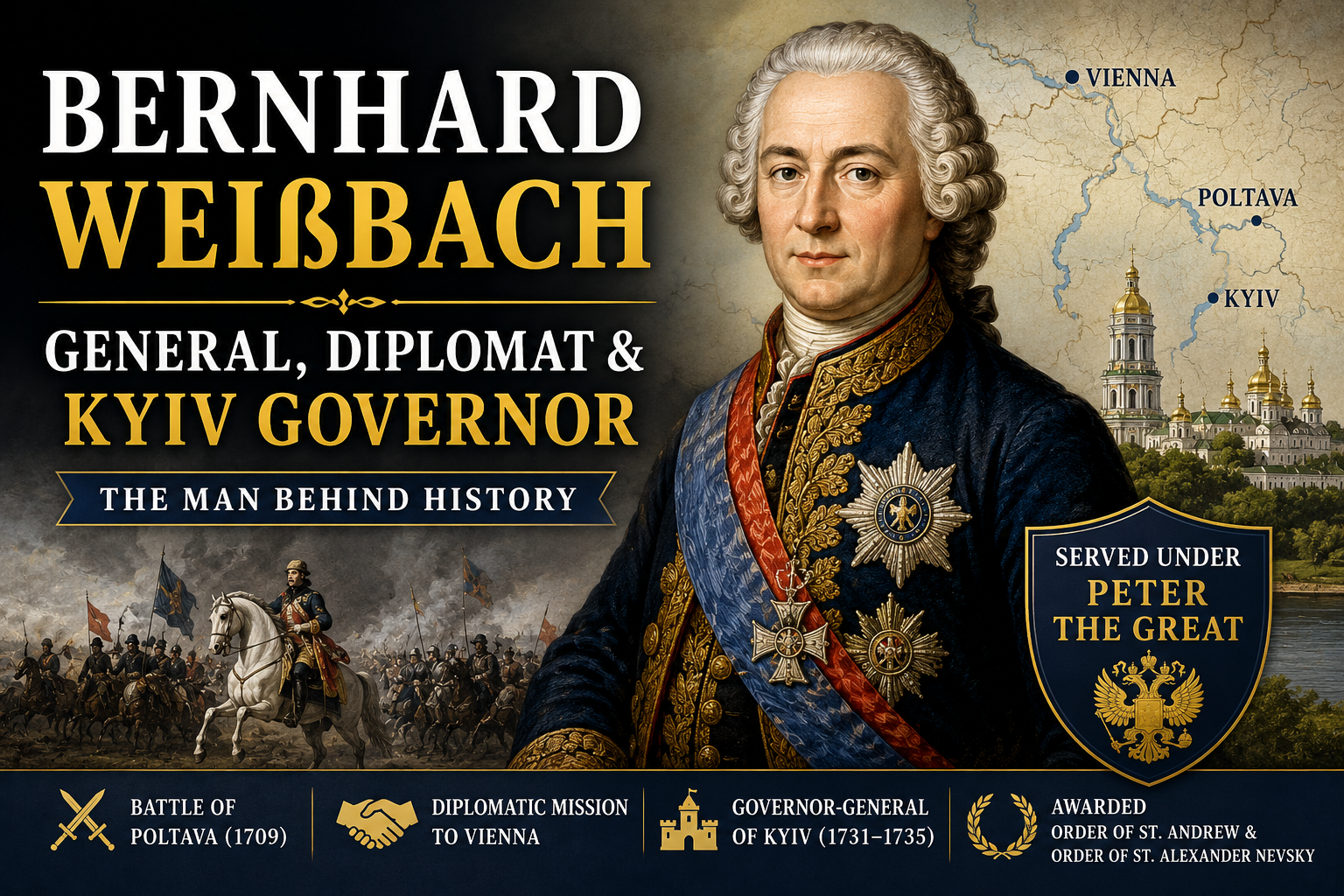
The name Bernhard Weißbach can be surprisingly difficult to research. Search results may show different spellings, genealogy references, and unrelated uses of the surname. In historical contexts, however, the name is most commonly associated with Johann Bernhard von Weisbach, an 18th-century cavalry general, diplomat, and imperial administrator who served the Russian Empire during the era of Peter the Great.
His career is notable because it crossed several worlds. He was a Central European military officer who entered Russian service, fought during the Great Northern War, took part in the Battle of Poltava, served as a diplomat in Vienna, became involved in the administration and defence of Ukraine, and eventually served as Governor-General of Kyiv from 1731 to 1735. The supplied historical material identifies him with several forms of the name, including Weißbach, Weissbach, Weisbach, Johann Bernhard Graf Weißbach, and the Russian transliteration Veisbakh.
What makes his story particularly interesting is not simply the number of positions he held. His life illustrates how military talent, diplomatic experience, imperial politics, and frontier administration were interconnected in early-18th-century Europe.
Who Was Bernhard Weißbach?
Bernhard Weißbach was not a modern celebrity or public personality. He was a historical military and political figure whose importance comes from his service to the Russian Empire.
The historical identity most often associated with the name is Johann Bernhard von Weisbach. He was born in 1665 and died in 1735. His career included service as a cavalry commander, diplomat, senior military officer, and administrator. He ultimately reached the rank of General of Cavalry and became Governor-General of Kyiv.
His career is especially significant because it demonstrates the mobility of elite military professionals during this period. Officers could move between political systems, serve foreign rulers, and use their military experience in diplomatic and administrative positions.
That makes Weisbach an excellent example of how European power worked before the modern nation-state system fully developed.
Bernhard Weißbach Name Variations Explained
One of the biggest challenges when researching Weisbach is spelling.
You may encounter:
- Bernhard Weißbach
- Bernhard Weissbach
- Johann Bernhard von Weisbach
- Johann Bernhard Graf Weißbach
- Weisbach
- Veisbakh
- Вейсбах
The differences are partly linguistic. The German character ß is frequently converted into ss, while Russian names were transliterated into Latin alphabets in different ways.
The supplied source specifically notes that the historical context is particularly important when determining identity. References to Peter the Great, Poltava, Vienna, Kyiv, or the Russian Empire strongly point toward Johann Bernhard von Weisbach.
This is an important research lesson: a historical figure should not be identified by spelling alone. Dates, locations, military positions, political associations, and contemporary records are often more reliable identifiers.
Early Life and Central European Background
Weisbach was born in 1665, although the precise description of his regional background varies.
Some historical accounts identify his origins with Bohemia, while other scholarship places him in a Silesian and Catholic Central European context. The supplied material explains that these differences are not necessarily surprising because Central Europe in the late 17th century contained overlapping political, religious, linguistic, and dynastic structures.
This context is important.
Modern readers often associate nationality with a fixed country. In Weisbach’s lifetime, political identity could be considerably more complicated. A person could be born in one territory, serve a ruler from another political structure, and later become an officer in a completely different empire.
That was particularly common among professional soldiers.
Why Peter the Great Needed Foreign Officers
Weisbach entered Russian service in 1707, at a crucial point in the reign of Peter the Great.
Peter was transforming Russia’s military institutions. His reforms required experienced officers who understood European military organisation, discipline, cavalry tactics, artillery, engineering, and logistics.
Foreign military specialists therefore became valuable to the Russian state.
Weisbach entered Russian service as a colonel and received command of a dragoon regiment. His military experience helped him become increasingly important within the Russian army.
A Unique Insight: Military Talent Was Also a Political Currency
One of the most interesting aspects of Weisbach’s career is that military competence did more than produce battlefield promotions.
In Peter’s Russia, a successful officer could become:
soldier → commander → senior officer → diplomat → administrator
Weisbach’s career followed much of this pattern.
His military service created the reputation and trust that later enabled him to perform diplomatic and administrative functions.
This helps explain why a cavalry officer eventually became a governor.
The Tykocin Episode
One of the early events associated with Weisbach occurred at Tykocin.
According to the supplied material, he successfully withdrew a Russian garrison without losses and destroyed the fortifications despite the presence of nearby Swedish forces. The action attracted Peter the Great’s attention and helped strengthen Weisbach’s reputation.
This episode is significant because military leadership during the Great Northern War required more than simply winning large battles.
Commanders had to make decisions about:
- Retreat
- Supply
- Fortifications
- Troop preservation
- Mobility
- Intelligence
- Timing
Preserving troops could sometimes be more strategically valuable than defending a position at any cost.
Weisbach During the Great Northern War
The Great Northern War was the central military environment of Weisbach’s early Russian career.
Russia was fighting Sweden for influence and territory in Northern and Eastern Europe. Sweden was then a major European military power under Charles XII.
Weisbach participated in campaigns near Holowczyn and Smolyany in 1708 and later fought near Rashevka in 1709. The supplied material describes these operations as important stages in his rise before the Battle of Poltava.
His cavalry experience was particularly useful.
Why Cavalry Was So Important
Cavalry was not simply an early version of modern armoured vehicles.
In the 18th century, cavalry could perform several critical functions:
- Reconnaissance
- Flank protection
- Pursuit
- Raiding
- Screening infantry movements
- Disrupting enemy formations
- Exploiting a retreat
A competent cavalry commander therefore needed mobility, discipline, tactical judgment, and an understanding of terrain.
Weisbach’s continued rise suggests that Russian leadership considered him capable of handling these responsibilities.
The Battle of Poltava
The Battle of Poltava in 1709 became the defining military event associated with Weisbach.
The battle was a major confrontation between the Russian army of Peter the Great and the Swedish forces of Charles XII. The Russian victory significantly weakened Swedish power and strengthened Russia’s position in Eastern Europe.
Weisbach’s role was more substantial than simply being present.
Historical material identifies him with Russian cavalry command on the right wing. He was wounded during the battle but remained involved and later participated in the pursuit of the defeated Swedish forces toward Perevolochna.
Why Poltava Changed Weisbach’s Career
Poltava was both a military and career turning point.
Following the battle, Peter promoted Weisbach to major general. This demonstrated that battlefield performance could translate directly into imperial advancement.
For Weisbach, Poltava helped establish three things:
- His battlefield credibility
- His value to Peter’s government
- His suitability for increasingly important assignments
The Pruth Campaign
In 1711, Weisbach participated in the Russian Pruth campaign against the Ottoman Empire.
The campaign was difficult for Russia and created serious challenges for Peter the Great’s forces. Nevertheless, Weisbach continued to serve in important military roles.
This phase of his career is important because it demonstrates that his experience extended beyond the Swedish-Russian conflict.
He was becoming an officer with experience across different strategic theatres.
Defence of Ukraine and the Southern Frontier
After the Pruth campaign, Weisbach became associated with the defence of Ukrainian territories against Crimean Tatar raids.
The supplied source records a 1713 victory near Bohodukhiv and explains that his responsibilities increasingly connected him with the southern frontier.
This was a complicated environment.
The region involved overlapping interests among:
- The Russian Empire
- Local Ukrainian political structures
- Cossack forces
- The Crimean Khanate
- The Ottoman Empire
- Other regional powers
Military administration in this environment therefore required more than battlefield skills.
It demanded political awareness.
A General Who Became a Diplomat
One of the most unusual parts of Weisbach’s career was his transition into diplomacy.
He was sent to Vienna, one of the most important diplomatic centres in Europe. The supplied source describes this as a significant stage in his career because he represented Russian interests in the Habsburg political environment.
Why Vienna Mattered
Vienna was a major centre of European diplomacy.
The Habsburg monarchy played a central role in European politics, while Russia was increasingly becoming a major power.
Weisbach’s Central European background and military experience made him particularly useful in this environment.
This is another unique feature of his biography: his foreign origin did not prevent him from becoming useful to Russia; it may actually have increased his diplomatic value.
He understood cultural and political environments outside Russia in ways that some purely domestic officials might not.
From Battlefield Commander to Imperial Administrator
After his diplomatic assignment, Weisbach returned to military and administrative duties.
He became associated with command responsibilities in Little Russia, later joined the Military College, and was promoted to General of Cavalry in 1725.
This illustrates the evolution of his career.
He was no longer simply a foreign officer recruited for battlefield expertise.
He had become part of the Russian imperial establishment.
Career Transformation
His career can be broadly understood as four stages:
| Stage | Main Function |
|---|---|
| Early career | Central European military experience |
| Russian service | Cavalry command |
| Mature career | Generalship and diplomacy |
| Final career | Imperial administration and Kyiv governance |
This combination explains why Weisbach remains historically interesting.
Imperial Honours
Weisbach’s status was reflected in the honours he received.
The supplied material states that he was raised to the rank of count by Emperor Charles VI and later received major Russian honours, including the Order of St. Alexander Nevsky in 1730 and the Order of St. Andrew in 1733.
These honours are particularly revealing because they demonstrate how his career crossed imperial boundaries.
He was associated with both:
- The Habsburg political world
- The Russian imperial system
That kind of cross-border elite career was possible because early-modern Europe was highly interconnected through dynastic politics, military service, diplomacy, and aristocratic networks.
Bernhard Weißbach as Governor-General of Kyiv
Perhaps the most important administrative position of Weisbach’s later life was his appointment as Governor-General of Kyiv in 1731.
He held the position until his death in 1735.
Kyiv was strategically important.
It was not simply a provincial city. It occupied a significant position in Russian military and political planning and was connected to wider issues involving Ukraine, the steppe, and the southern frontier.
A governor-general therefore needed to manage both civil administration and security.
The Ukrainian Line and Frontier Defence
During his Kyiv years, Weisbach was associated with defence planning involving the Ukrainian Line, a system of fortifications designed to protect the southern frontier.
This provides an important connection between his early and late careers.
As a young officer, Weisbach had learned battlefield command.
As a senior official, he was now involved in the broader strategic problem of how an empire protects its frontier.
That required:
- Fortifications
- Troop deployment
- Logistics
- Regional administration
- Intelligence
- Coordination with military commanders
In this sense, his final administrative career was a natural extension of his military experience.
A Unique Historical Connection: Poltava Bookends His Life
One of the most striking details of Weisbach’s biography is the connection between Poltava and both the beginning and end of his historical legacy.
In 1709, Poltava was where he became associated with one of Russia’s most important military victories.
In 1735, he died in Poltava while preparing for a campaign toward Crimea.
This gives his biography an unusual circular quality.
The same city that became associated with his military reputation also became the place where his life ended.
His Final Campaign
In 1735, Weisbach was preparing for a campaign against Crimean Tatar forces and toward Crimea.
However, he died before completing the operation.
The supplied source records that he died in Poltava while still involved in active imperial responsibilities rather than during a peaceful retirement.
His death therefore came at the end of a career that had remained connected with military affairs for decades.
Why Bernhard Weißbach Matters Today
Weisbach is not famous in the same way as Peter the Great or Charles XII.
Yet his biography provides a useful window into a period of enormous political change.
His life helps explain:
- How Russia recruited foreign military specialists
- How professional officers moved between military and diplomatic roles
- Why Poltava mattered to Russia’s rise
- How Ukraine became strategically important to Russian imperial policy
- How frontier administration worked
- How European aristocratic networks crossed political borders
His biography is therefore valuable even without modern celebrity status.
The Bigger Historical Picture
The story of Bernhard Weißbach cannot be separated from the transformation of Russia under Peter the Great.
Peter wanted Russia to become a stronger European power.
Military modernisation was central to that objective.
Foreign officers could bring knowledge that Russia wanted to acquire quickly. Officers such as Weisbach were therefore part of a larger transformation rather than isolated individuals.
His career demonstrates how institutional modernisation can depend on the movement of expertise across borders.
That is one of the most useful lessons from his biography.
Bernhard Weißbach Timeline
| Year | Major Event |
|---|---|
| 1665 | Born in Central Europe |
| 1707 | Entered Russian service as a colonel |
| 1708 | Participated in campaigns near Holowczyn and Smolyany |
| 1709 | Fought near Rashevka |
| 1709 | Participated in the Battle of Poltava |
| 1709 | Promoted following Poltava |
| 1711 | Took part in the Pruth campaign |
| 1713 | Associated with fighting against Crimean Tatar forces |
| 1718 | Connected with cavalry command in Ukraine |
| 1719 | Sent to Vienna on a diplomatic mission |
| 1720 | Returned to military responsibilities in Little Russia |
| 1723 | Joined the Military College |
| 1725 | Promoted to General of Cavalry |
| 1730 | Received the Order of St. Alexander Nevsky |
| 1731 | Became Governor-General of Kyiv |
| 1733 | Received the Order of St. Andrew |
| 1735 | Died in Poltava |
The timeline is based on the supplied historical material, which records the major stages of his military, diplomatic, and administrative career.
Bernhard Weißbach Name Guide
| Name | Context |
|---|---|
| Bernhard Weißbach | German-style search form |
| Bernhard Weissbach | Spelling without ß |
| Johann Bernhard von Weisbach | Major historical form |
| Johann Bernhard Graf Weißbach | Form incorporating his count title |
| Weisbach | Simplified surname |
| Veisbakh | Russian transliteration |
| Вейсбах | Cyrillic form |
These variants explain why searches for the same historical figure can produce apparently different results.
Was Bernhard Weißbach a Celebrity?
No.
Calling him a “celebrity” in the modern sense would be misleading.
He was a historical military and political personality. His importance comes from his connection to Peter the Great, the Great Northern War, Poltava, Vienna diplomacy, and the administration of Kyiv.
A better description is:
General. Diplomat. Imperial administrator. Historical figure.
What Made His Career Unusual?
Several features make Weisbach stand out.
1. He served more than one political world
His Central European origins and later Russian career show how military professionals could cross political boundaries.
2. He combined military and diplomatic work
Many historical commanders were primarily soldiers. Weisbach also represented Russian interests diplomatically.
3. He moved into high-level administration
His appointment as Governor-General of Kyiv demonstrates that his role eventually extended beyond the battlefield.
4. His career survived political change
He remained useful through different phases of Russian imperial politics after Peter the Great.
5. His story connects several major historical locations
His life intersects with:
Vienna → Poltava → Ukraine → Kyiv → Russian imperial administration
That geographic range is one reason his biography is more interesting than a simple military profile.
Frequently Asked Questions
Who was Bernhard Weißbach?
Bernhard Weißbach is most commonly associated with Johann Bernhard von Weisbach, an 18th-century cavalry general, diplomat, and imperial administrator who served Russia.
What was Bernhard Weißbach known for?
He is primarily associated with Russian military service, the Battle of Poltava, diplomatic work in Vienna, and his role as Governor-General of Kyiv.
Was Bernhard Weißbach a real person?
Yes. The supplied historical material identifies the figure behind the name as Johann Bernhard von Weisbach, also appearing under several spelling variations.
Was he connected to Peter the Great?
Yes. Weisbach served Russia during Peter the Great’s era and advanced through the military and administrative system associated with Peter’s reforms.
What was his role at Poltava?
He was associated with Russian cavalry command on the right wing during the Battle of Poltava. He was wounded but remained active and participated in the pursuit of Swedish forces afterward.
When was he Governor-General of Kyiv?
He served as Governor-General of Kyiv from 1731 to 1735.
Where was Bernhard Weißbach born?
The available historical material indicates disagreement over his exact regional origin, with sources describing either Bohemia or a Silesian/Central European background.
When did he die?
He died in 1735 in Poltava while preparing for a campaign toward Crimea.
Why are there so many spellings of his name?
The name appears across German, English, and Russian historical traditions. Weißbach can become Weissbach or Weisbach, while Russian transliteration produces forms such as Veisbakh.
Conclusion
Bernhard Weißbach, best identified with Johann Bernhard von Weisbach, was far more than a name appearing in historical search results.
He was a Central European-born officer who entered Russian service during a period of extraordinary imperial expansion. He became a cavalry commander, fought at Poltava, participated in campaigns against Sweden and the Ottoman sphere, helped defend Ukraine’s southern frontier, represented Russian interests in Vienna, received high honours, and eventually became Governor-General of Kyiv.
His biography is particularly valuable because it demonstrates that military, diplomatic, and administrative careers were not always separate in early-modern Europe.
Weisbach’s life moved through all three.
His connection to Poltava is especially striking: the city was associated with one of the greatest victories of his military career, and it was also where he died decades later while preparing for another campaign.
For modern readers, the most important lesson is perhaps the simplest one: historical identity requires context. Bernhard Weißbach, Bernhard Weissbach, Johann Bernhard von Weisbach, and Veisbakh may look like different search terms, but in the right historical context they lead to the same remarkable figure—a general, diplomat, and imperial administrator whose career stretched across Central Europe, Russia, Ukraine, and the major power struggles of the early 18th century.