Who Is Donna Sicuranza? Untangling Two Different Women, One Shared Name
Introduction
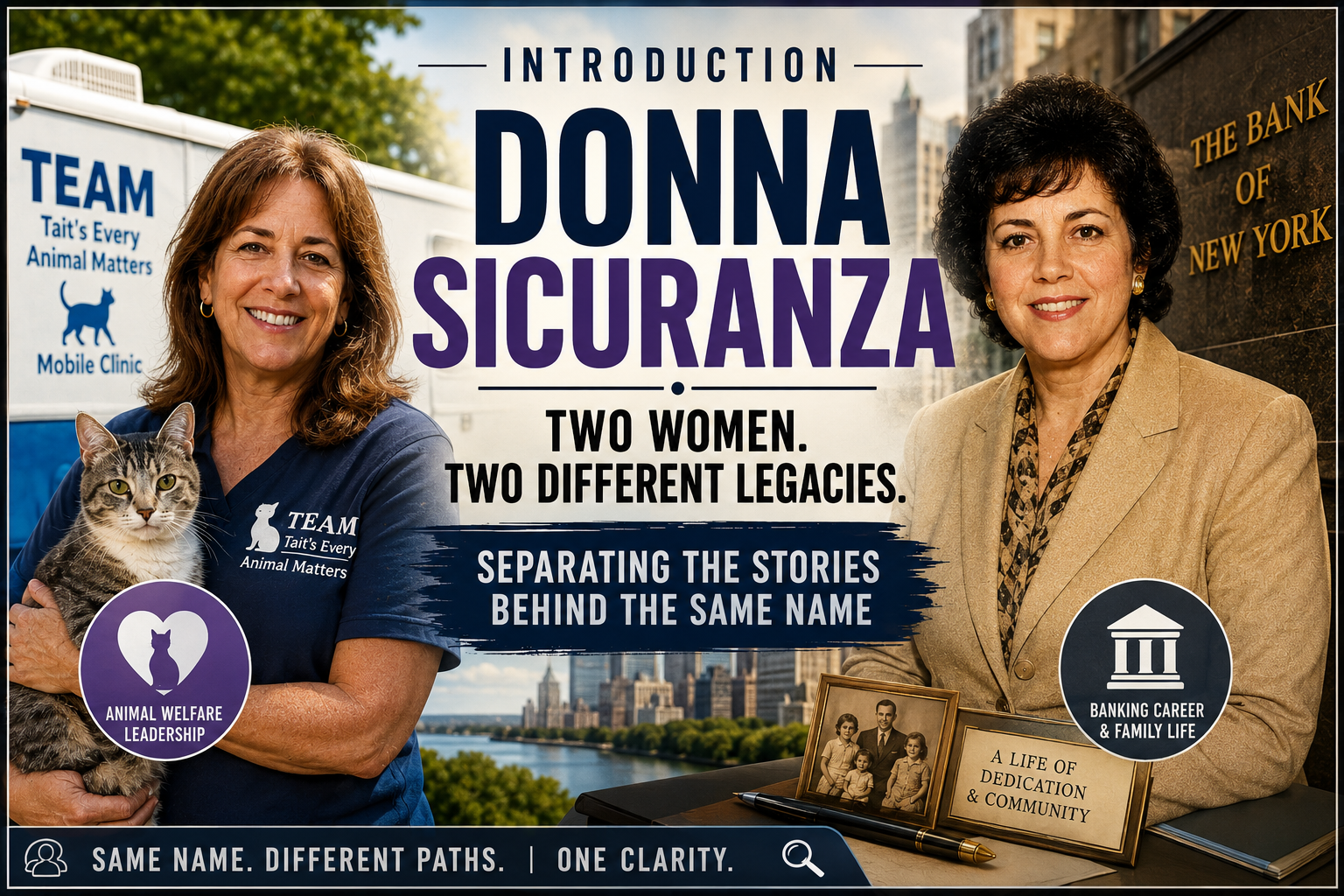
Search for “Donna Sicuranza” and you’ll quickly discover that the name doesn’t point to a single life story — it points to two. One woman built a career in animal welfare, co-founding a nonprofit that transformed access to veterinary care for cats in Connecticut. The other spent decades in the New York banking world before passing away in 2017. Because both women share the same first and last name, their stories are often blended together online, which does a disservice to each of them. This article separates the two clearly, tells the fuller story of the woman most people are actually searching for, and is upfront about which details are solidly confirmed versus which ones are still murky.
The Name in Context
Most contemporary references to “Donna Sicuranza” are actually about Donna Sicuranza Marconi, the co-founder and Executive Director of Tait’s Every Animal Matters (TEAM), a Connecticut-based nonprofit. A second woman, Donna Marie Sicuranza, lived a very different life centered on family and a long banking career in New York before her death in 2017. Their paths never crossed in any documented way — they simply shared a name, and search engines have a way of flattening that distinction.
A Small Fleet, a Big Idea
On a March morning in 1997, a specially outfitted van pulled into a Connecticut parking lot. Inside was an exam table, surgical equipment, and a small team ready to work. Outside, cat owners and feral-cat caretakers waited — some who’d driven a while to get there, others who lived just down the road but had never had an affordable option this close to home.
By the end of that first day, somewhere between ten and twelve cats had been spayed, neutered, or vaccinated. The exact number depends on which account you read, and that’s telling in itself: this wasn’t a headline-grabbing launch. It was a quiet start to something that would eventually reshape how an entire state approached feline overpopulation.
The woman behind that van — and the organization that grew from it — is Donna Sicuranza, known in official records today as Donna Sicuranza Marconi, Executive Director of TEAM, based in Westbrook, Connecticut.
From Editor’s Desk to Executive Director
What makes Sicuranza’s story more interesting than the average nonprofit-founder bio is where she started. Before animal welfare, multiple accounts agree she spent years as a writer, editor, and public relations professional, work she was doing through the 1980s and into the 1990s.
That background isn’t just trivia. Nonprofit leadership lives or dies on the ability to explain a mission clearly, raise money from people who’ve never met you, and keep a community’s trust over decades — not years. Someone who spent their early career learning how to make a message land had a real head start when she pivoted into running a charity that needed exactly that skill, over and over, for the next 25-plus years.
(A caveat worth being upfront about: some sources list specific degrees and dates for her education — a bachelor’s in English from one university, a master’s from another — but these details appear in only a single source each and aren’t independently confirmed elsewhere, so they’re presented here as reported rather than verified.)
Building TEAM, One Mile at a Time
Sicuranza didn’t build TEAM alone. Multiple sources consistently credit Dr. John A. Caltabiano, a Connecticut veterinarian, as her co-founder and the medical force behind the mobile clinic concept. He brought the clinical expertise; she brought the leadership, communications, and organizational glue that kept a mobile veterinary operation running for decades. Several accounts describe him as her longtime partner in both the professional and personal sense, though the personal details around that relationship are thinly sourced and worth treating with caution.
What isn’t in dispute is the scale of what they built. TEAM’s mobile unit didn’t stay a single van forever — it grew into a fleet of specially designed vehicles capable of handling exams, surgery, and recovery on the move. And the numbers, cited consistently across independent sources, are genuinely striking:
- Since 1997, TEAM has sterilized and vaccinated more than 225,000 cats — domestic and feral — across Connecticut.
- The program has run continuously for more than 25 years, an unusually long lifespan for a niche nonprofit service.
- TEAM’s current medical leadership is separate from Sicuranza’s role — she’s listed as Executive Director on the administrative side, while a Medical Director (reported as Dr. Art Heller) oversees the veterinary work today, a structure that reflects how the organization has professionalized since its scrappier early days.
To put 225,000 cats in perspective: that’s roughly the population of a mid-sized American city, entirely made up of animals who — without a mobile, low-cost option — might never have been sterilized or vaccinated at all. Each one represents a cat owner who couldn’t get to (or afford) a traditional veterinary hospital, or a feral-cat caretaker managing a colony with their own time and money.
Why “Mobile” Was the Whole Point
It’s worth sitting with why the mobile model mattered so much, rather than treating it as an operational footnote. Before TEAM’s clinic existed, low-cost feline sterilization in Connecticut was mostly confined to fixed shelter locations — meaning if you didn’t live near one, or didn’t have reliable transportation, you were largely out of luck.
The mobile clinic flipped that equation. Instead of asking the community to come to the service, the service went to the community. That’s a small operational choice with outsized consequences:
- Population control: Spaying and neutering reduce unplanned litters, easing pressure on shelters and rescue organizations already stretched thin.
- Preventive health: Vaccinations and routine exams catch problems early, before they become costlier or harder to treat — issues that might otherwise go unnoticed entirely.
- Support for informal caregivers: People who care for stray or community cats — often unpaid and under-resourced — get a practical way to do more with less, without needing to transport a dozen semi-wild cats across town.
Other rescue networks in the region reportedly took notice, and versions of the mobile-clinic model spread beyond Connecticut’s borders in the years that followed — though the specifics of that regional influence are described more confidently in some sources than others.
Leadership Beyond the Clinic
Running a nonprofit like TEAM required more than medical expertise. As Executive Director, Sicuranza Marconi has been tied to the operational backbone of the organization — fundraising, staffing, scheduling, vehicle upkeep, and coordination with local communities and officials. Her involvement reportedly extended into broader statewide conversations about animal population control, where veterinarians, nonprofit leaders, and government representatives compare notes on what’s working and what needs to change.
That kind of advocacy reflects a recognition that no single clinic can solve animal welfare challenges alone. Durable progress tends to require a mix of public education, affordable services, sound policy, and cooperation across organizations — and Sicuranza Marconi’s career is often cited as an example of how sustained, hands-on nonprofit work can feed into that larger picture.
Sorting Fact from Noise
Here’s where the story gets genuinely messy, and it’s worth explaining why. A search for “Donna Sicuranza” surfaces a wave of near-identical articles from content sites, many of which appear to recycle the same core facts while adding small, unconfirmed details — a marriage date, a specific alma mater, a slightly different cat count from opening day. Some of these details may be accurate. Others may simply be filler generated to pad out an article. Without a single authoritative source (like a detailed TEAM press release or investigative profile) to check them against, the honest move is to flag them rather than present them as settled fact.
What’s consistently corroborated, across multiple independent write-ups:
- She leads TEAM as Executive Director.
- The organization is based in Westbrook, Connecticut.
- The mobile clinic launched in 1997.
- TEAM has sterilized/vaccinated more than 225,000 cats since then.
- Dr. John A. Caltabiano co-founded the program with her.
- She has a professional background in writing, editing, and public relations prior to her nonprofit career.
What’s reported but not independently confirmed:
- The exact number of cats treated on opening day (accounts vary between 10 and 12).
- Specific degrees, universities, and graduation years.
- Details of a personal relationship or marriage.
Donna Marie Sicuranza: A Life in New York
The second Donna Sicuranza — Donna Marie Sicuranza — was born in March 1942 to Dominic and Felicia Russillo and raised in Pelham, New York. In 1960, she married Angelo Sicuranza, and the couple went on to raise three children together.
Her professional life included a stint at Walker Studios followed by more than two decades at the Bank of New York, where she remained until retiring in 2007. That length of tenure speaks to a career built on consistency and institutional trust rather than career-hopping.
Outside of work, she and her husband traveled, with trips to destinations including Italy and South Africa. Donna Marie Sicuranza died in March 2017, and her funeral was held in Pelham — the community where her family roots were deepest.
Every source that discusses the TEAM executive is careful to draw a hard line between the two women — different careers, different states, different decades of public record — and that line is worth holding onto. They are not the same person, related, or connected in any documented way. They simply share a name that search engines have flattened into one confusing result page.
Telling the Two Apart
Because both women share a name, online records can blur together — biographies, nonprofit press materials, and memorial notices all use the same search terms. The clearest way to separate them is by context clue:
| If the reference mentions… | It’s likely about… |
|---|---|
| TEAM, mobile veterinary clinics, cats, or Connecticut | Donna Sicuranza Marconi |
| Pelham, the Bank of New York, Angelo Sicuranza, or a 2017 obituary | Donna Marie Sicuranza |
Keeping these details straight matters — not just for accuracy, but out of respect for two distinct life stories that happen to share a name.
The Bigger Picture
Strip away the SEO noise, and what’s left is a fairly unglamorous but genuinely admirable story: someone with no veterinary background used communications skills honed over more than a decade to help build and sustain a nonprofit that has now run for over 25 years and touched hundreds of thousands of animals. It didn’t happen through a single dramatic moment — it happened through one van, one parking lot, one cat at a time, repeated often enough that the numbers eventually became remarkable.
Donna Marie Sicuranza’s legacy, by contrast, is a quieter and more private one: a long career in banking, a marriage and family built over decades, and a life rooted in Pelham, New York. Neither story overlaps with the other, but together they’re a reminder of how easily two people’s histories can get tangled up online simply because they share a name — and why it’s worth taking the time to untangle them.
Frequently Asked Questions
Who is Donna Sicuranza?
The name is most commonly associated with Donna Sicuranza Marconi, the Executive Director of Tait’s Every Animal Matters (TEAM) in Westbrook, Connecticut — but it also belonged to Donna Marie Sicuranza, a retired New York banking professional who died in 2017.
What is Donna Sicuranza Marconi known for?
Co-founding and leading TEAM, a nonprofit that has run a mobile feline spay/neuter/vaccination clinic since 1997 and has sterilized and vaccinated more than 225,000 cats across Connecticut.
What does TEAM stand for?
Tait’s Every Animal Matters — a Connecticut nonprofit focused on accessible feline veterinary care.
Who co-founded TEAM with her?
Dr. John A. Caltabiano, a Connecticut veterinarian, is consistently credited as her co-founder and the medical driving force behind the mobile clinic.
Was Donna Sicuranza involved in animal population control efforts?
Yes. Her work has included both direct sterilization services and participation in broader state-level discussions on the topic.
Who was Donna Marie Sicuranza?
A Pelham, New York native who worked at Walker Studios and then the Bank of New York for more than 20 years, retiring in 2007. She died in 2017.