The Tatavel Mystery: A Deep Dive Into How a Single Word Became Five Different “Products” Online
1. Introduction
Type “Tatavel” into a search engine and you’ll find no shortage of confident, detailed “complete guides.” Each one promises to explain exactly what Tatavel is, how it works, and why you should care. The problem is that they don’t agree with each other — not on category, not on function, not on a single verifiable fact. This article digs into why that’s happening, what it reveals about a broader pattern on the modern web, and how to protect yourself from it as a reader.
2. The Five Competing Identities of “Tatavel”
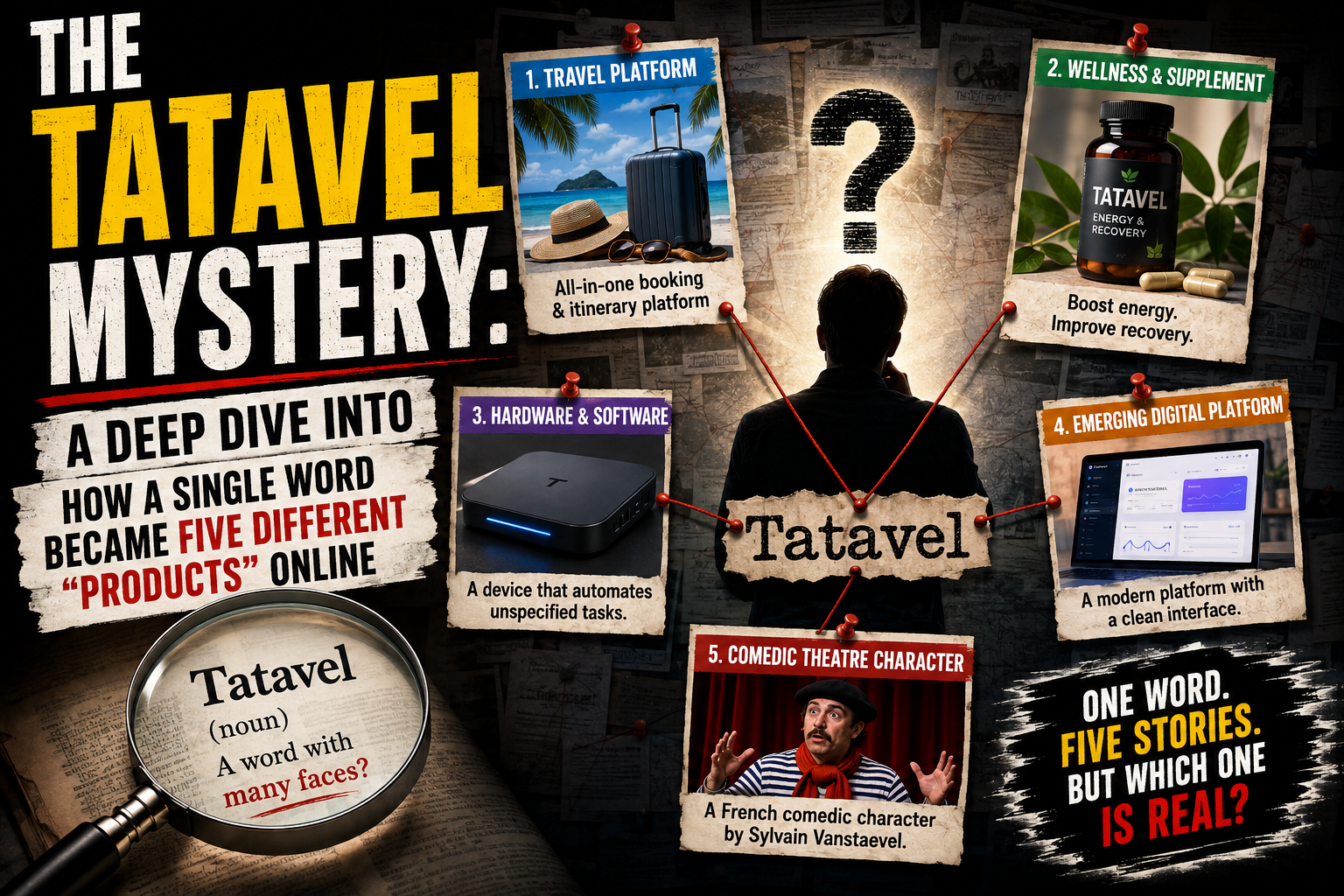
Pulling together what’s actually been published under this name, “Tatavel” has been described as:
- An all-in-one travel booking and itinerary platform
- A wellness and supplement system aimed at boosting energy and workout recovery
- A vague hardware-and-software device for automating unspecified tasks
- A generic “emerging digital platform” with no defined purpose beyond a clean interface
- A French comedic theatre character, created and performed by Sylvain Vanstaevel
That’s not five articles disagreeing on details — it’s five articles disagreeing on the basic category of thing being described. A real product doesn’t get described this inconsistently across independent sources.
3. A Closer Look at Each Claim
The travel platform version leans heavily on generic value propositions — “centralized dashboard,” “real-time pricing,” “personalized recommendations” — without naming a company, an app store listing, a founding team, or funding history. No screenshots, no verifiable customer reviews, no support contact.
The wellness version uses classic supplement-marketing language — “science-backed,” “cellular level,” “mitochondrial function” — terms borrowed from real biology to sound credible, but attached to no clinical studies, no ingredient list, and no regulatory disclosures (which legitimate supplement marketing in most countries is required to carry).
The hardware/software version is the vaguest of all: it describes an “unboxing” and “guided wizard” without ever naming what the device actually does, who manufactures it, or what problem it claims to solve.
The “emerging platform” version is essentially content-free — praise for a “clean interface” and “mobile compatibility” that could describe nearly any website ever built.
The comedy-character version is different in kind: it names a real performer (Sylvain Vanstaevel), describes an actual art form (one-man theatrical comedy), and situates the subject within a real cultural context (French regional versus urban social satire). It’s the only entry with enough specificity to actually investigate further.
4. The One Claim That Actually Checks Out
The theatrical Tatavel is worth separating out because it behaves like real information: a named creator, a describable body of work, a genre, and a cultural throughline (jokes about provincial life meeting metropolitan culture). Even if you can’t instantly verify every detail, this account has the texture of something built from actual research rather than pattern-generated text. The other four entries don’t.
5. How Content Like This Gets Made
This is a recognizable production pattern, often associated with large-scale AI-assisted content generation aimed at search engines rather than readers:
- Keyword discovery — tools flag a term getting search volume, often because it’s unusual, foreign, newly coined, or ambiguous enough that no single dominant source has claimed it yet.
- Rapid publishing — because there’s no real subject to research, writers (human or automated) fill a standard template: Introduction, Key Features, Benefits, How It Works, Who It’s For, Limitations, Future Outlook, Conclusion. Notice this is nearly the exact structure of the earlier “Tatavel” document you shared.
- Category guessing — different publishers guess at different plausible categories (travel, wellness, tech gadget) based on nothing but instinct or whatever seems trending, which is exactly why the guesses diverge so wildly.
- Cross-linking and syndication — the same boilerplate phrases get reused or lightly reworded across multiple domains to build volume and internal link networks.
6. The Business Model Behind It
None of this happens for free. The economics are straightforward:
- Ad revenue: pages earn money per visit regardless of whether the content is accurate.
- Affiliate links: especially visible in the wellness version, which is a common setup for supplement affiliate marketing — get someone curious about a trending name, then route them toward a purchase.
- Domain/SEO speculation: publishing early on a term that might become a real trending brand can pay off if that brand does take off later, since the site may already rank.
- Content-mill volume contracts: some sites are paid per published article regardless of topic, incentivizing speed over accuracy.
7. Why Search Engines Struggle to Filter It Out
Search engines rank largely on relevance and engagement signals, not ground truth. A page that’s well-structured, uses the target keyword frequently and naturally, loads fast, and gets clicked on can rank well even if its factual content is invented. Detecting “this article describes a product that doesn’t exist” is a much harder problem for automated systems than detecting spam or malware — it requires cross-referencing claims against independent, verifiable sources, which most ranking systems don’t do at scale.
8. The Real-World Risks
- Wasted time: readers genuinely trying to learn about something walk away with nothing usable.
- False confidence in a purchase or download: if a reader believes the wellness or travel-platform version is real and acts on it, they could hand over payment details or personal data to something with no accountable owner.
- Misinformation compounding: once enough low-quality guides exist, they start citing or resembling each other, making the false impression of consensus stronger over time.
- Erosion of trust in “how-to” and “guide” content broadly, which has knock-on effects for genuinely useful educational writing.
9. A Practical Checklist for Spotting Fabricated “Guides”
- Does the article name a real company, founder, or organization — not just the product name?
- Are there specific, checkable details (pricing, release date, headquarters, app store listing) rather than only adjectives (“modern,” “seamless,” “innovative”)?
- Do independent sources describe the same category of thing, or does the description shift from source to source?
- Does the writing hedge suspiciously (“depending on context,” “information remains limited”) while still claiming to be a “complete guide”?
- Does the structure look templated — the same section headers you’d expect on literally any topic (Key Features, Benefits, Limitations, Future Outlook)?
- Search the name alongside “reddit,” “reviews,” or “scam” to see if real users are discussing it outside of guide-style articles.
10. What This Says About the Future of Web Search
Cases like this are becoming a recognized problem in discussions about the health of the open web: as content generation gets cheaper and faster, it becomes easier to flood search results with plausible-sounding but empty or contradictory material before any authoritative source exists. It’s a reminder that being well-written and highly ranked is not the same as being true, and that verification — cross-referencing multiple independent, specific sources — matters more, not less, as this kind of content becomes more common.
11. Case Study: A “Tatavel FAQ” That Illustrates the Pattern Perfectly
To make the pattern concrete, here’s a real example of the kind of FAQ block that circulates with these guides — reproduced with a note on why each answer is structurally empty, despite sounding informative.
“What is Tatavel?”
Answer given: “an emerging term… its exact meaning may vary depending on context.” Why it’s empty: This defines nothing. A real FAQ answer names a category and a function. “Its meaning may vary” is a way of answering without answering.
“Why is Tatavel becoming popular?”
Answer given: people are curious, and search/social media raised awareness. Why it’s empty: This is circular — it explains popularity by citing popularity (“search engines… have helped increase awareness of the term”), without saying what drove the initial interest.
“Is Tatavel associated with a specific industry?”
Answer given: no, it could touch tech, travel, lifestyle, branding, or digital services. Why it’s empty: Listing five unrelated industries as equally plausible is the opposite of an answer — it signals nobody actually knows.
“What are the potential uses of Tatavel?”
Answer given: could be a brand name, platform, creative initiative, or community concept. Why it’s empty: Every one of those “potential uses” applies to almost any invented word. This sentence would be equally true (and equally useless) if you replaced “Tatavel” with a random string of letters.
“How does Tatavel’s future look?”
Answer given: it depends on adoption; it “may become more prominent” if people find value in it. Why it’s empty: This is true of literally everything that doesn’t yet exist. It commits to no prediction and no fact.
This FAQ format is common precisely because it looks thorough — five headers, five paragraphs, a reassuring structure — while conveying zero verifiable information. It’s a useful template to keep in mind: if you can swap the subject name for any other unfamiliar word and the answers still read fine, the content isn’t actually about that subject.
12. Conclusion
“Tatavel” isn’t one mystery product waiting to be explained — it’s a snapshot of how quickly the web can generate confident-sounding nonsense around an ambiguous name. The only piece of the puzzle that holds up under scrutiny is the French comedic theatre act by Sylvain Vanstaevel; everything else circulating under the name reads as speculative or fabricated filler built to capture search traffic. If you’re researching this term for a specific reason, the most useful next step is going back to whatever original source first mentioned it to you, rather than trusting any of these generic online guides.